Debugging: Learning things the hard way
Writing code for a wide variety of project is a great way to learn new things and getting smarter. But sometimes, it's a painful and inefficient process. Let me introduce you to: the debugging hell. Of course, some bugs are caused by you not having a big enough brain to see that your code is not correct for this particular case. But very often, the issue is that you don't know enough about the environment around your program. This includes libraries, weird decisions in standards, or how your OS works. I learned some things this way. As I said, it's not efficient, and moreover it will probably never be useful to you. But anyway, here is a rant of random stuff I learned this way.- hashing in python is not deterministic. A salt is added before each execution, so when you try to setup a persistent cache is does not work.
- iframes need a closing tag, even if nobody puts stuff inside. If you do
<iframe src="x.pdf"/>, everything after the iframe will be invisible on your page. You need<iframe src="x.pdf"></iframe> -
Monkey-C, the programming language created by Garmin that is smartwatch-oriented (they're geniuses), is weird. They have a concept called a Symbol. It's a compile-time construct, like a named constant pointer you can use instead of an enum. But when you create a menu, the identifiers of the choices are automatically converted to these Symbols. And funnily enough, you can't store Symbols in the device storage. So if you do a menu, get the choice of the user, store it in the long-term memory of the file, and try to retrieve it, you will get a crash without any error message. I you want the text associated with the menu option the user just clicked, have to do something like that:
var categoryStrings = { :work => Rez.Strings.CategoryWork, :friends => Rez.Strings.CategoryFriends, :family => Rez.Strings.CategoryFamily, :domestic => Rez.Strings.CategoryDomestic, :administrative => Rez.Strings.CategoryAdministrative, :hobbies => Rez.Strings.CategoryHobbies, :transport => Rez.Strings.CategoryTransport, };- And of course, one day I changed the definition of the menu and I forgot to change this mapping. It compiled fine, and then the app crashed again, on my wrist !
- Some UTF-8 characters are not associated with a specified representation. They are called Private user area characters. When you type one of these special symbols, what you see depends on your font. Try to paste this into other apps:
,and my favourite: - in Systemd, if you don't enable the
graphical.target, your graphical environment won't start. - When you have "automatic reload libraries" enabled in Marimo, and you update a library, it will be indeed reloaded. So it will also update the cells that use this library. The thing is that if you used
marimo.dropdownto select an item interactively, it will be reset to it's default value. AND WHAT HAPPENS IF YOU WERE ANALYSING A COMPLEX DATASET IN VECTOR SPACE AND THAT THE DEFAULT VALUE OF THE DROPDOWN IS A DUMMY DATASET THAT DOES NOT BEHAVE LIKE THE OTHERS ? Well, you try to find the error for a looong time. - If you want to disable part of your smartphone screen, you need to use ADB with this command:
adb shell wm overscan. But to do it on modern devices, you need a root access. To do this you need to unroot your phone. Do do it you need to access your bootloader. And it turns out like some manufacturers like OPPO Neo 5 make it almost impossible to unroot your device. The only tool on the web with a potential way to do it was a windows bash script written in chineese referenced on a WPS office document linked on a Reddit post. And it can brick your device if you're not lucky. - Fedora uses Selinux, a linux kernel security module. And this module creates bug with a lot of software. I mean a lot. Just look at the number of github issues related to it, it's huge. For example, I encountered it while trying to install the nix package manager
- On Linux, all your wifi connections are stored in
/etc/NetworkManager/system-connections. But if you try to archive them somewhere to reuse them on another computer, you will realize that it does not contain passwords, just the rest of the config. - In javascript, if you define a script in:
<head><script> ... </script></head>, it will run when the page loads. But if you try to get an element withgetElementById, it will fail. Indeed, the script is executed before the entire HTML tree is loaded. You need to add the defer attribute to make sure it is executed after the HTML loads. - In previous versions of typst, the
typefunction returned a string. After 0.7, it returns a specialtypeobject. For some time, the compiler warned you that it was going to be deprecated but it let you compare with strings. Now it just do not work, and the compiler tells you nothing. -
I am obsessed with github issues. When I try a new #OpenSource library, and I notice something strange, I immediately reproduce it, create a Minimal Reproducible Example, and fill an issue. And very often, my issue ends with "It took hours before I realize the issue came from your library".
- (Just bragging, here is the list of the > 200 issues I opened: https://github.com/search?q=is%3Aissue%20author%3Arambip&type=issues)
- In the bokeh ploting library, the smart ticking is probably too smart
- In the same library, if you want to know what the available symbols for plotting are (
Markertypes in bokeh's terminology), you go to the documentation of the "Marker" class right ? Wrong, you have to go to "Scatter". And there is no link from Marker to Scatter
- (this list will probably keep growing, unless 1°: I die or 2°: I am so sick about computers I decide to become a cook instead.)
-
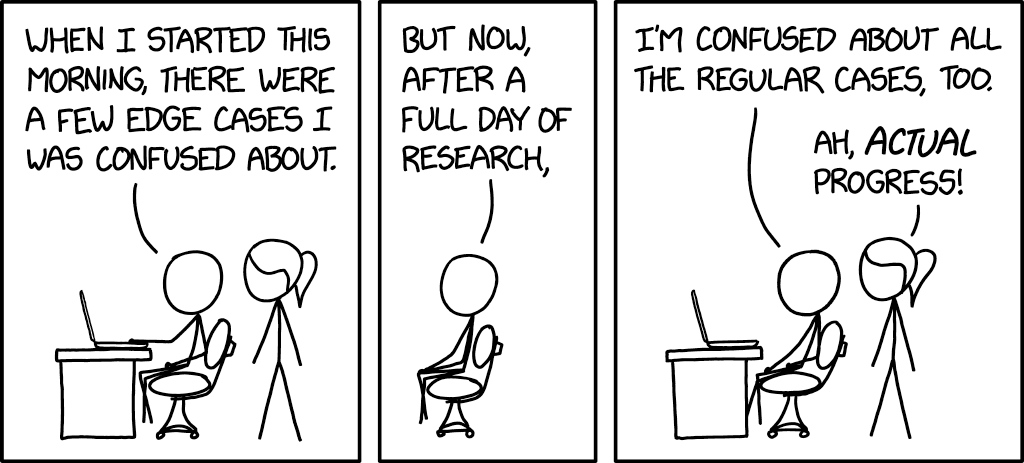
- credits: xkcd